Beyond the Bedside
Redefining Every Nurse as a Researcher

Who truly bears responsibility for nursing research—the bedside nurse or the nurse educator?
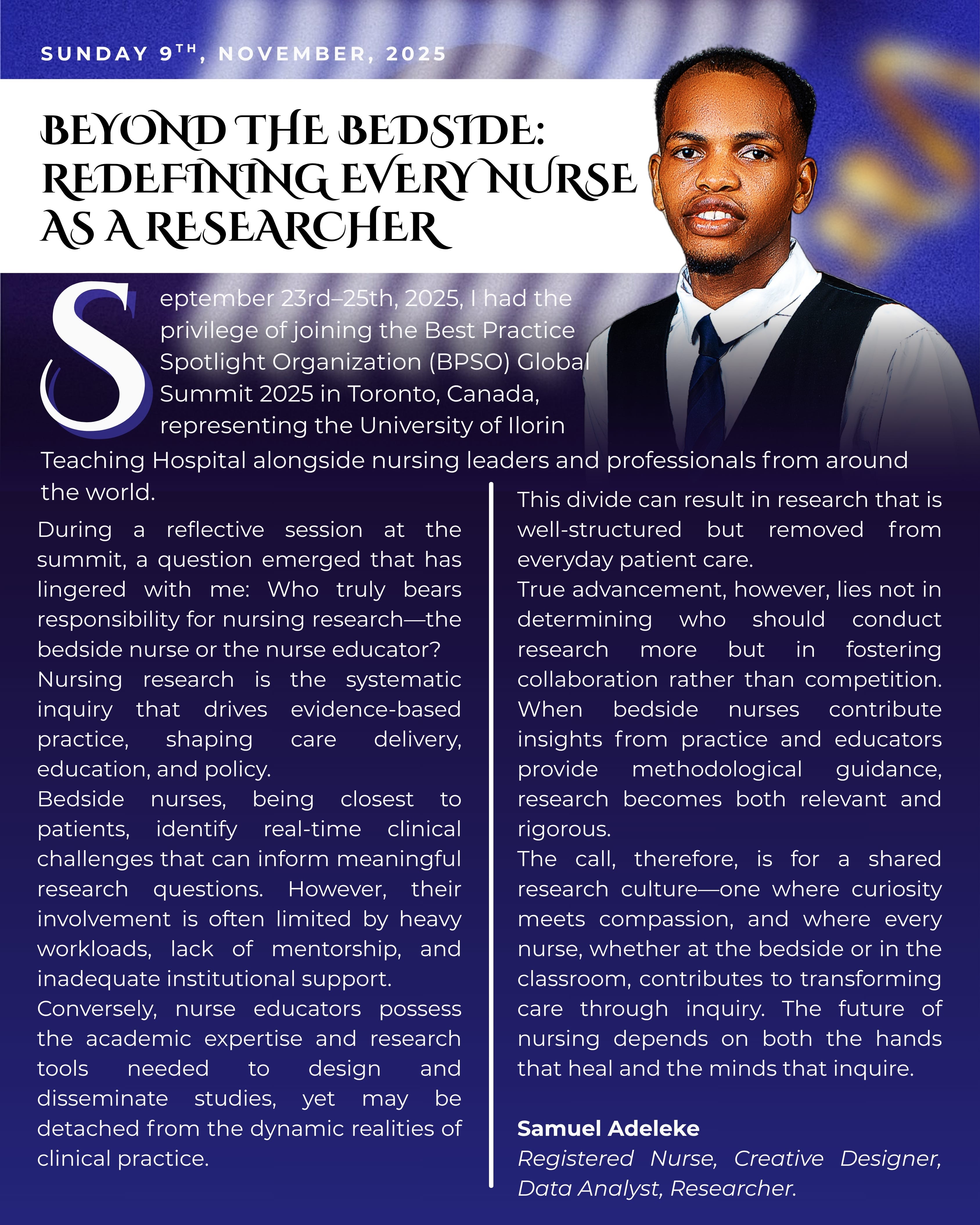
On September 23rd-25th, 2025, I was privileged to join the Best Practice Spotlight Organization Global Summit 2025, held in Toronto, Ontario, Canada, from my institution (University of Ilorin Teaching Hospital), together with Nursing leaders and professional colleagues.
During the break, we had an internal interactive session to recap what had been learnt, which prompted nurses, especially those in the clinical setting, to embrace research as a problem-solving approach and a means of contributing to the profession.
It made me ask: who truly bears responsibility for nursing research—the nurse at the bedside or the educator in the classroom?
Nursing research is a systematic inquiry designed to develop knowledge about issues of importance to the nursing profession, including nursing practice, education, administration, and informatics. Nursing research plays a vital role in today’s health care environment. By taking a more scientific and analytical approach to nursing practice, not only do patient outcomes improve, but the entire field of nursing does as well.
Bedside nurses witness the day-to-day realities of patient care — pain points, clinical patterns, and protocol gaps. Their direct contact gives them unique insights that can generate practice-based research questions. However, clinical workload, lack of research training, and limited institutional support often restrict their involvement.
Nurse educators, on the other hand, possess the academic tools and resources to conduct and publish research. Their role is to train others in evidence-based practice, yet they sometimes lack direct exposure to real-time clinical dynamics. This can create research that is academically sound but disconnected from bedside realities.
Nurse researchers play a vital role in all aspects of health care delivery, from policy development to nurse education to community health best practices. They contribute to foundational knowledge essential to all nurses and support the notion of evidence-based care, which underpins health care delivery.
This article aims to enhance Collaboration, Not Competition, because actual progress happens when both parties collaborate. Bedside nurses bring real-world problems; nurse educators bring methodological expertise. When research becomes a shared culture, not a segmented duty, nursing evolves beyond routine to revolution.
So, who should conduct research more?
Perhaps the answer isn’t who, but how we can empower both.
Research should no longer be the privilege of academia, but the heartbeat of every nurse who desires change.
The future of nursing depends on both the hands that heal and the minds that inquire.